
Sell First or Buy First in San Diego? A Move-Up Guide
Should You Sell Your San Diego Home Before Buying Your Next One?

If you own a home in San Diego and want to move into another, there's a decision to make before you start shopping: sell first or buy first?
Neither is automatically better.
Selling first generally gives you financial certainty and access to your sale proceeds. Buying first may give you more control over the home search and moving schedule, but can require extra financing and the ability to carry two properties.
The right answer is not simply whichever option sounds easier. It's whichever one lets you move into a home that improves your life without creating financial pressure you can't comfortably manage.
Why It's Especially Tricky for Move-Up Buyers
Imagine you own a two-bedroom bungalow in North Park. You love the area, but now you want more space, a home office, usable outdoor space, or a larger garage. You're looking at detached homes in South Park or Mission Hills.
You may have built substantial equity, but most of your wealth is still tied up in your current property. You need to coordinate an existing mortgage, a sale, a down payment, another mortgage, and a move.
You're not just buying. You're coordinating two major transactions and trying to keep your household functioning in between.
Option One: Sell First
Selling your current home first can give you greater clarity. Once the property closes, you know the proceeds after loan payoff and transaction expenses. You can plan your next down payment around actual available money rather than an estimate.
It may also simplify mortgage qualification because the previous housing debt has been paid off. And you generally avoid paying mortgages on two homes at once.
Those are meaningful advantages.
The Problem: What Happens Between Homes?
What if the house sells and you haven't found the next one?
You might need temporary housing, storage, two moves, or some other arrangement. More importantly, you might feel pressured to purchase a property that doesn't really fit.
I don't want a homeowner buying a house they'll regret because the closing date on their previous home is approaching. Selling first can be an excellent strategy, but the backup housing plan deserves as much attention as the listing plan.
Option Two: Buy First
Buying first can mean more freedom to find the right next property. You may be able to move directly into it, then prepare and show the old house while vacant.
That could be a big advantage if painting, repairs, staging, or frequent showings would be disruptive while you're living there.
You may also be able to make a purchase offer without conditioning it on the sale of your old home, depending on your financing.
The Problem: Two Properties Cost Money
If your old home takes longer to sell, what happens?
Two mortgage payments, taxes, insurance, utilities, maintenance, and potentially repair costs can add up quickly.
And the price you ultimately receive from selling may not match your original assumptions.
A lender approving you for financing is not the same as the household being comfortable with the risk. The real question is whether your life and finances can support the overlap even if the original home takes longer to sell.
What If the Down Payment Is Tied Up in Your Current Home?

Home equity and cash in the bank are not the same thing.
Suppose your current house has an illustrative market value of $1 million and a $450,000 mortgage balance. That's roughly $550,000 of gross equity.
But it doesn't mean you have $550,000 available to spend. Selling expenses, liens, other obligations, and loan payoff reduce actual proceeds. And the equity must be accessed before it can fund your next down payment.
Potential options include:
Home Equity Line of Credit (HELOC)
A qualified homeowner may be able to borrow against an existing property's equity. HELOC availability, rates, payments, and limits depend on credit, income, the property, and lending requirements.
Bridge Loan
A bridge loan can provide temporary financing between the purchase of a new property and sale of an existing one. Such financing may involve higher costs or shorter repayment terms, and qualification varies.
Qualifying for Both Mortgages
Some homeowners have sufficient income, assets, and reserves to qualify for the new mortgage while retaining the old one. The lender will evaluate debt-to-income ratio and other requirements.
Home-Sale Contingency
An offer can potentially make the next purchase contingent on the sale of the existing home. A seller may decline that condition or prefer a competing offer with fewer contingencies. Protections depend on the actual contract language.
None of these options is universally available, and all should be evaluated with a properly licensed financing professional.
A Third Strategy: Coordinate the Two Closings
Some homeowners can arrange a sale and purchase to occur close together, perhaps by aligning escrow dates or negotiating a rent-back after selling.
A rent-back can permit temporary occupancy after closing, but it requires agreement and attention to lending, insurance, contract, and timing requirements. Coordinated transactions can also be vulnerable to delays: a problem with one closing may affect the other.
This can work well, but it needs a detailed plan, not a hopeful assumption that everything will line up.
Why Central San Diego Changes the Conversation
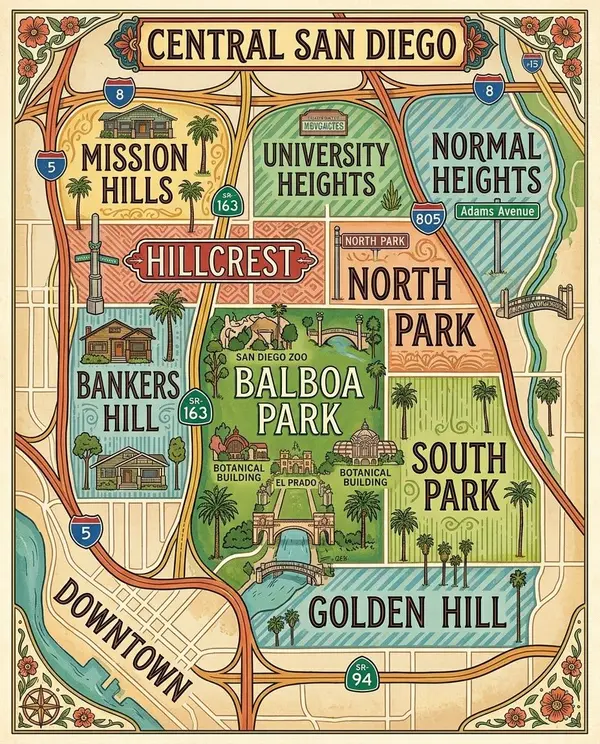
The housing stock around Balboa Park varies dramatically.
Going from a North Park condo to a South Park detached house can mean a different price range, set of ownership expenses, maintenance responsibilities, and type of competition.
Moving from an older Golden Hill bungalow to a larger Mission Hills home may require a very specific combination of bedrooms, parking, floor plan, and outdoor space.
And those features aren't interchangeable. A household needing a usable two-car garage and a fourth bedroom may not be able to substitute just any property with more square footage.
The more specific the replacement home's requirements, the more important it is to understand what's realistically available before committing to the timing of the sale.
Similarly, if the current home needs extensive preparation, buying first may help you sell a vacant property. But you have to compare the possible marketing benefits with the cost and risk of carrying two homes.
The neighborhood decision and the financing decision have to work together.
The Three Questions I'd Answer Before Choosing
1. How Much Equity Is Actually Available?
Estimate sale proceeds after mortgage payoff and selling expenses, then identify how much can be accessed before or after closing.
2. What Can You Comfortably Carry?
A lender's maximum approval isn't necessarily your ideal household budget. Consider cash reserves and how long you could tolerate overlapping housing costs.
3. How Flexible Is Your Timeline?
Could you use temporary housing? Is moving twice feasible? How exact are the features you need in the next home? How will you respond if either transaction is delayed?
These questions turn an abstract “buy first or sell first?” debate into a plan for the life you're actually living.
Sell First vs Buy First: At a Glance
| Factor | Sell First | Buy First |
|---|---|---|
| Access to existing sale proceeds | After closing | May require alternate financing |
| Risk of overlapping payments | Usually lower | Potentially significant |
| Time to find next home | May become urgent | More flexible |
| Temporary housing | Sometimes needed | Often avoidable |
| Moving logistics | May involve two moves | Often one move |
| Financing complexity | Generally simpler | May be more complex |
| Major risk | Gap between homes | Carrying two properties |
These are general patterns, not guarantees. Specific contracts, financing, and property conditions can change the result.
Which Would I Recommend?

If you need the existing home's proceeds to fund the next purchase and don't want the financial risk of overlap, selling first often gives you a clearer path.
If you have substantial reserves, comfortable qualifying capacity, and very specific requirements for the next property, buying first may be worth considering.
If your situation is somewhere between those extremes, look at coordinated closings or appropriate contract contingencies.
I wouldn't choose your strategy because someone else did it that way. Your finances, existing property, and next-home goals are different.
The goal is to improve your life, not to become house poor.
Frequently Asked Questions
Should I sell my house before buying another in San Diego?
Selling first generally makes sense when you need the sale proceeds for the next down payment or want to avoid carrying two mortgages. Buying first may make sense when finances and reserves support an overlap.
Can I buy before selling?
Possibly, through available cash, qualifying for both loans, a HELOC, bridge financing, or another lender-approved arrangement. Some purchases use home-sale contingencies.
What is a home-sale contingency?
It's a contract provision making the buyer's obligation to complete a purchase dependent on specified conditions related to selling another property. Exact terms matter, and sellers need not accept one.
Can I use equity for the next down payment?
You may be able to use net sale proceeds or qualified equity-based financing. Actual availability depends on property value, debt, lender rules, and costs.
What if I sell and can't find a replacement home?
Plan for temporary lodging, storage, or a negotiated post-closing occupancy arrangement where feasible, before committing to the sale schedule.
Is buying first always riskier?
Not necessarily. It can create financial exposure from overlapping ownership, while selling first can create housing and timing pressure. Assess the risks you can actually absorb.
Final Thoughts
Your next San Diego home should fit your next chapter, not become a financial burden.
Before you list your existing house or make an offer on the next one, understand your available equity, financing, options for coordinating timing, and realistic property requirements. Then build a plan around those facts.
If you're planning a move in North Park, South Park, Golden Hill, Mission Hills, University Heights, or elsewhere in Central San Diego, I'd be happy to talk through the options.
Book a conversation: https://thornberghomegroup.com/calendar-1
Real connections. Real results.
About Matt
Matt Thornberg is a San Diego real estate agent and team leader of Thornberg Home Group who follows how San Diego’s changing places influence the experience of living here. He helps first-time homebuyers and current homeowners move up, downsize, or relocate through deep local knowledge, straight-shooting advice, and proven marketing and negotiation strategy. Matt specializes in the central San Diego neighborhoods surrounding Balboa Park, including Golden Hill, South Park, North Park, Mission Hills, University Heights, Normal Heights, Hillcrest, and Bankers Hill. Let’s talk about your next move.
Categories
- All Blogs (12)
- bankers hill (1)
- central san diego (1)
- downtown san diego (2)
- golden hill (1)
- hillcrest (1)
- living in san diego (8)
- mission hills (1)
- moving to san diego (2)
- neighborhood guides (1)
- normal heights (1)
- north park (3)
- san diego (9)
- san diego history (6)
- san diego lifestyle (8)
- san diego living (10)
- san diego neighborhoods (4)
- san diego news (7)
- san diego nightlife (1)
- san diego real estate (4)
- san diego restaurants (2)
- south park san diego (4)
- university heights (2)
Recent Posts





GET MORE INFORMATION