Jack in the Box Started on El Cajon Boulevard: The San Diego Story Behind the Drive-Thru
Jack in the Box Started on El Cajon Boulevard: The San Diego Story Behind the Drive-Thru
Here's a piece of San Diego history that I think is pretty frickin cool.
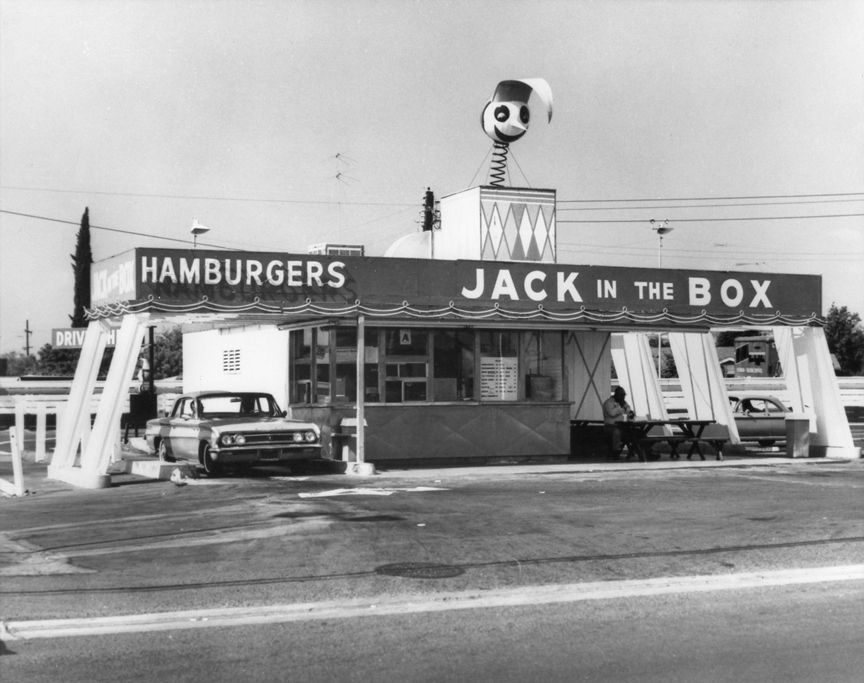
One of America's most recognizable fast-food chains started right here on El Cajon Boulevard, in a tiny hamburger stand that sold burgers for 18 cents and had a giant clown head sticking out of the roof.
And the really interesting part isn't just that Jack in the Box was founded in San Diego.
It's that this little restaurant helped change the way Americans order food.
Today, pulling up to a speaker, ordering a burger, driving forward, and picking it up without leaving your car is about as ordinary as it gets.
But in 1951? That was still a pretty unusual experience.
And San Diego was right in the middle of making it popular.
Where Was the First Jack in the Box?
The first Jack in the Box opened in 1951 at 6270 El Cajon Boulevard, near 63rd Street, in San Diego's College Area.
The man behind it was Robert Oscar Peterson, a local businessman who had already been involved in the restaurant industry for years.
The site had previously operated under his earlier restaurant concepts, including Topsy's and Oscar's, before becoming Jack in the Box.
So Peterson wasn't starting completely from scratch. He had experience running restaurants, and he'd already seen how much Southern Californians loved eating in their cars.
What he recognized was an opportunity to do things a little differently.
Instead of having customers park and wait for someone to walk out to their car, why not build a restaurant around getting drivers through as quickly as possible?
That idea became the foundation of Jack in the Box.
And El Cajon Boulevard was a pretty great place to test it.
Why El Cajon Boulevard Was the Perfect Location
To understand why this happened in San Diego, you've got to picture the city in the early 1950s.
This was the age of car culture.
Southern California was growing, more people were driving, and streets like El Cajon Boulevard were important commercial corridors.
Drive-in restaurants were especially popular because people could pull into a parking spot and have food brought out by a carhop.
Restaurants weren't just places to eat. They were places to gather, show off your car, and spend time with friends.
El Cajon Boulevard became particularly well known for its cruising culture.
And the intersection of El Cajon Boulevard and 63rd Street was right in the middle of that world.
In fact, according to SDSU Magazine's look back at the university's historic off-campus hangouts, the original Jack in the Box became a favorite spot for San Diego State students and local high schoolers.
The publication even describes young drivers showing off their hot rods and parking along 63rd Street.
Think about that for a second.
Today, you might pass through the College Area without thinking twice about this intersection.
But decades ago, it was part of the local car culture that helped give birth to a national restaurant chain.
That's the kind of San Diego history I love finding.
The Talking Clown That Helped Change Fast Food
Now here's where the story gets really interesting.
The original Jack in the Box wasn't just another burger stand.
Its entire business model revolved around the drive-thru.
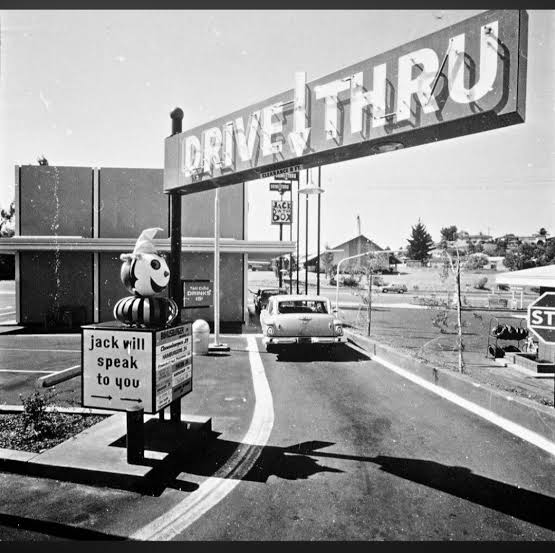
Customers would pull up, place an order through a two-way intercom, move forward, pick up their food, and leave.
One vehicle could be placing an order while another was receiving food.
That helped make the process faster and more efficient than relying entirely on traditional carhop service.
And the restaurant used one of the strangest marketing ideas you could imagine.
A clown.
A giant clown head sat on top of the building, while the circus-inspired design made the restaurant almost impossible to overlook from the street.
Even better, a sign instructed motorists:
"Pull forward, Jack will speak to you."
Imagine seeing that in 1951.
You're sitting in your car, about to order a hamburger, and you're being told that some clown named Jack is going to start talking to you.
Today, nobody thinks twice about a voice coming through a drive-thru speaker.
But at the time, ordering through an intercom was unfamiliar enough that customers needed an explanation.
The Smithsonian's National Museum of American History documents how Jack in the Box restaurants used two-way speakers and distinctive architecture to help introduce this style of service to customers.
And here's an important distinction.
Jack in the Box did not invent the drive-thru restaurant.
Drive-thru service existed before 1951, including at California restaurants such as In-N-Out Burger.
What Jack in the Box helped pioneer was the large-scale use of the two-way intercom and a restaurant model built around drive-thru service.
That distinction matters because the real story is interesting enough without claiming Jack in the Box invented something it didn't.
It helped turn a developing idea into a recognizable part of American food culture.
And that happened right here in San Diego.
Hamburgers for 18 Cents and a Very Different Menu
One of my favorite details about the original Jack in the Box is the price.
A hamburger cost just 18 cents.
Not $1.80.
Eighteen cents.
Of course, that was 1951 money, when wages and prices were very different from what they are today.
But it's still pretty incredible to think about when you compare it with ordering fast food in 2026.
The original menu was much simpler than what we've come to expect from Jack in the Box.
The concept was about speed, convenience, and serving a limited selection of food without making the process complicated.
Over time, the chain expanded its menu and began offering more of the unusual combinations that eventually became part of its identity.
There's even a piece of Jack in the Box history in the Smithsonian's collection: an early-1960s drive-thru menu sign made in a San Diego sign shop.
The museum describes a menu featuring 18-cent hamburgers and 25-cent tacos.
Yes, Jack in the Box was selling tacos decades ago.
Which is kind of funny when you consider how closely those tacos are still associated with the chain today.
You can see the Smithsonian artifact here:
https://americanhistory.si.edu/collections/object/nmah_1417795
The San Diego Architect Behind Jack's Wild Original Design
Another part of this story that deserves more attention is the architecture.
Those original Jack in the Box buildings weren't just functional hamburger stands.
They were designed to get noticed.
The architect responsible for the distinctive early Jack in the Box designs was Russell Forester, a San Diego architect and artist who also worked on Peterson's earlier Oscar's restaurants.
In a 1995 interview with the San Diego Reader, Forester discussed the thinking behind the original buildings.
The design was built around the idea of getting food into a customer's hands quickly while attracting the attention of drivers passing by.
The restaurants combined exaggerated signage, geometric forms, and a giant clown with a compact layout that supported drive-thru service.
Forester described how elevating the Jack character helped make the buildings noticeable from the road.
And the architecture did something pretty clever.
The building itself became part of the advertising.
You didn't need to drive past a billboard to see Jack in the Box.
The restaurant was the billboard.
According to historical research published by the La Mesa Historical Society, Forester eventually designed around 200 Jack in the Box buildings for Peterson's company.
So this little restaurant concept on El Cajon Boulevard helped launch an entire architectural identity.
Unfortunately, the original restaurant at 6270 El Cajon Boulevard has since been demolished.
And that's one thing I find a little disappointing.
We have so many interesting stories hiding around San Diego, but not every building survives long enough for people to recognize its significance.
The Founder Also Has a Surprising Connection to San Diego City Hall
This is one of those unexpected connections that makes local history so much fun.
Robert Oscar Peterson, the founder of Jack in the Box, was married to Maureen O'Connor.
If that name sounds familiar, there's a good reason.
O'Connor became San Diego's first female mayor, serving from 1986 to 1992.
So the founder of one of America's best-known fast-food chains was also married to a major figure in San Diego political history.
And the connections go even deeper.
Peterson and Russell Forester also collaborated on a remarkable residential property in Point Loma.
The estate was designed in a Japanese-influenced modernist style, with dramatic roofs, glass walls, water features, and a setting overlooking San Diego Bay.
Preservation organization Save Our Heritage Organisation has documented the property's architectural importance and later restoration.
It's a completely different side of the people behind those original hamburger stands.
From giant clown heads on El Cajon Boulevard to a distinctive modernist home in Point Loma.
That's a pretty unusual architectural legacy.
What Happened to the Original Jack in the Box?
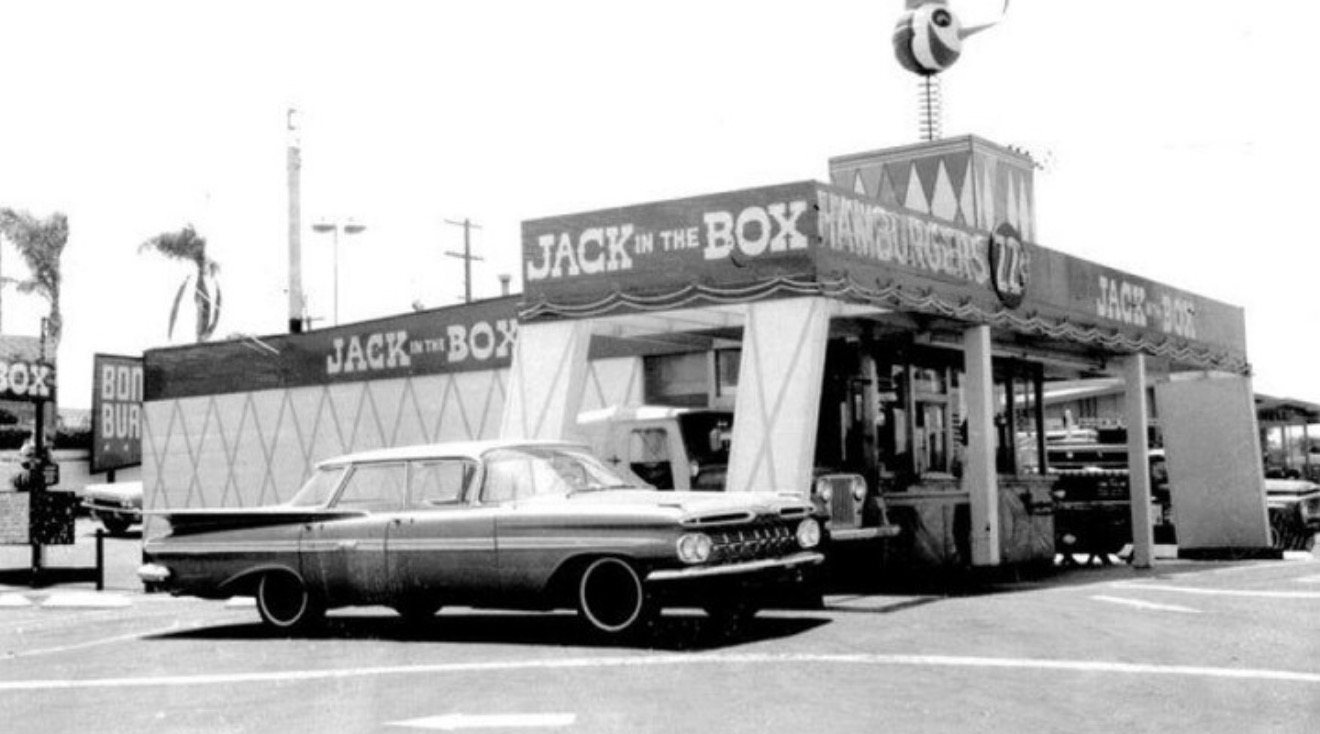
The original restaurant at 6270 El Cajon Boulevard no longer exists.
The building was demolished, and the early circus-inspired design eventually disappeared from the company's newer restaurants.
As the chain expanded, its architecture and marketing changed.
In 1980, the company famously began moving away from its original clown image.
The old Jack character was even blown up in television advertising as part of a campaign to introduce a more mature image.
That's one way to rebrand a restaurant.
But Jack wasn't gone forever.
The modern Jack character later returned to advertising in a very different form, becoming the familiar, suit-wearing mascot with the oversized white head that people recognize today.
And while the original El Cajon Boulevard restaurant is gone, you can still find some genuine pieces of its history.
You Can Still See a Vintage Jack in the Box Clown Head in Balboa Park
This might be my favorite part of the whole story.
There's a piece of Jack in the Box history at the San Diego History Center in Balboa Park.
The museum has preserved a vintage Jack in the Box clown head from the restaurant chain's earlier years.
In June 2026, KPBS featured the clown head as part of its reporting on a San Diego History Center exhibition.
The exhibit included artifacts tied to San Diego's history, and that old clown head was among them.
It's a pretty perfect place for it.
The original restaurant helped change American fast food, but the company is also part of San Diego's own cultural history.
The cars, the cruising, the food, the unusual architecture, the giant clown.
It's all connected to a particular moment in the city's development.
And seeing an actual artifact makes that history feel a little more real.
If you're interested in checking it out, the San Diego History Center is located in Balboa Park. Confirm current exhibit availability before visiting because museum displays can change.
More information:
Jack in the Box Celebrated 75 Years in 2026
In 2026, Jack in the Box celebrated its 75th anniversary.
The company marked the milestone with nostalgic menu items, special promotions, and anniversary-themed products.
That's 75 years since Robert Oscar Peterson opened that little drive-thru stand on El Cajon Boulevard.
And the company's influence stretches far beyond San Diego.
The two-way speaker, the drive-thru window, the focus on convenience, and the recognizable roadside branding all became defining features of American fast-food culture.
Jack in the Box wasn't responsible for inventing every one of those ideas.
But it played an important role in bringing them together and popularizing the experience.
And the whole thing traces back to a busy street near San Diego State.
Why I Love Finding Stories Like This Around San Diego
One of the things I love most about San Diego is how much history is hiding in places that seem completely ordinary.
You can drive through the College Area, stop at a traffic light, grab a coffee, and never realize something pretty significant happened just down the street.
That's why I think neighborhood history matters.
It's not always about the grand buildings, famous landmarks, or big historical events.
Sometimes it's a little hamburger stand on a busy road.
A local businessman trying something different.
A San Diego architect creating a building nobody could ignore.
And a bunch of local teenagers hanging out in their cars, completely unaware that the restaurant they were visiting would eventually become a major American brand.
The next time you're driving along El Cajon Boulevard near 63rd Street, think about that.
One of the most familiar experiences in American fast food has an important piece of its history right there.
And it started with 18-cent burgers and a talking clown.
That's frickin cool.
I love this frickin city.
About Matt Thornberg
I'm Matt Thornberg, a San Diego Realtor with Thornberg Home Group at eXp Realty and the creator of Live + List SD. I love exploring the history, neighborhoods, people, businesses, and experiences that make living in San Diego so interesting.
If you're thinking about buying, selling, or making a move here, I'd love to help you find not just the right home, but the right place to live your life.
No pressure. Just real conversations and a plan that makes sense for you.
Matt Thornberg | Thornberg Home Group | eXp Realty
DRE 02021076
Categories
GET MORE INFORMATION