
The El Cortez Glass Elevator: San Diego's Lost Sky-High Attraction
The El Cortez Glass Elevator: San Diego's Lost Sky-High Attraction
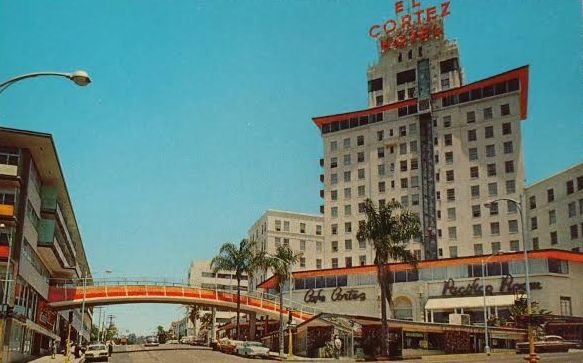
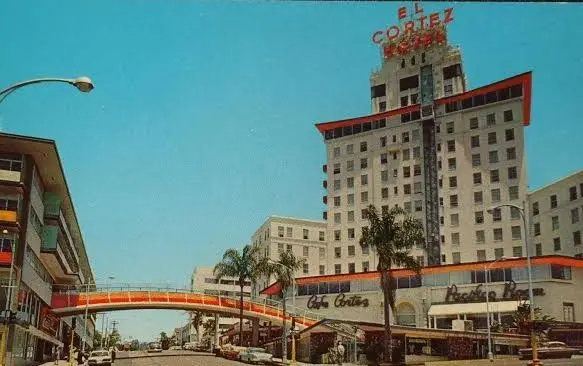
There's a building on Cortez Hill that thousands of San Diegans probably drive past without giving it much thought.
The El Cortez.
You know the one. That big white building on Ash Street with the giant red neon sign on the roof.
It's been part of San Diego's skyline for almost a century, and there's a pretty good chance you've seen it hundreds of times.
But here's something I find fascinating.
Back in the 1950s, this building had a glass elevator that climbed 15 stories up the OUTSIDE of the hotel.
And this wasn't just a clever architectural feature. It was an attraction in its own right.
People actually lined up to ride the thing!
It was called the Starlight Express, and it was one of the world's earliest exterior glass elevators.
The story behind it is even more interesting than the elevator itself.
Before the Glass Elevator, the El Cortez Was Already a San Diego Landmark
To understand why the Starlight Express was such a big deal, we have to go back to 1927.
That's when the El Cortez Hotel first opened at 702 Ash Street.
At 15 stories tall, it became the tallest building in San Diego.
Think about what downtown looked like back then. No modern skyline packed with glass towers. No giant high-rise condominiums surrounding the waterfront.
The El Cortez stood above the city as one of its most recognizable buildings.
And it wasn't just tall. It was glamorous.
The hotel attracted prominent visitors, hosted elegant gatherings, and became a destination for special occasions.
Its architecture was inspired by Spanish Colonial Revival design, and its elevated location on Cortez Hill gave visitors spectacular views of downtown, the harbor, and the surrounding city.
Then, in 1951, hotelier Harry Handlery purchased the property.
And he had some pretty ambitious plans.
Harry Handlery Wanted More Than Just a Hotel
Handlery wasn't interested in simply maintaining the El Cortez as another downtown hotel.
He wanted to make it a destination.
During the 1950s, he added a swimming pool, expanded the guest accommodations, and created new dining and entertainment spaces.
Among those additions was the Starlight Room on the 12th floor, along with the Sky Room on the 15th floor.
Imagine going out for the evening in San Diego during the 1950s.
You put on your best clothes, head downtown, meet some friends, and take an elevator high above the city for dinner, dancing, or cocktails.
From the Sky Room, guests could look out over San Diego through enormous windows and enjoy panoramic views that few other places in the city could offer.
That alone would have been pretty spectacular.
But Handlery wanted the trip to the top to be part of the experience.
And that's where things got really interesting.
Introducing the Starlight Express
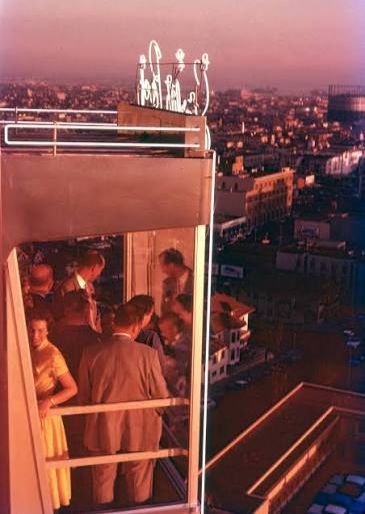
On May 10, 1956, the El Cortez officially unveiled the Starlight Express.
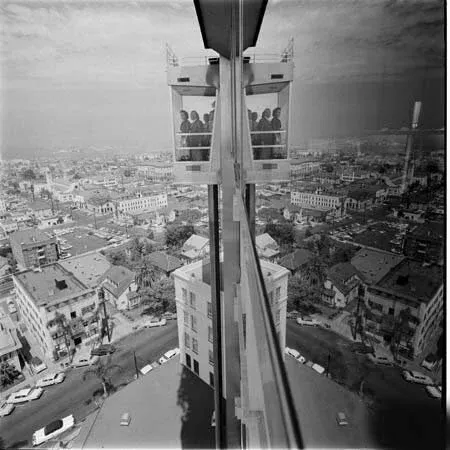
A glass-enclosed elevator attached to the OUTSIDE of the building.
Instead of stepping into a traditional elevator and staring at four walls while moving between floors, guests could watch the city unfold beneath them.
The higher they climbed, the more San Diego opened up around them.
Downtown streets, rooftops, the harbor, and the city lights all became part of the experience.
And as if the glass elevator wasn't interesting enough, glowing neon stars decorated the structure alongside it.
At night, the whole thing must have been an incredible sight.
One of my favorite details comes from historical accounts of people who actually rode the elevator.
A woman named Daisy Burns Munchtando described the experience in an essay that won a writing contest. She recalled 16 passengers entering the glass enclosure, soft music playing, and the city appearing almost unreal beneath them.
Others remembered the tremendous views, especially after dark.
And on busy Friday and Saturday nights, lines sometimes stretched from the hotel lobby all the way out to the street.
People weren't just taking an elevator to dinner.
They were going for a ride.
The Engineering Was Absolutely Wild
Here's the part that really caught my attention.
The Starlight Express wasn't built like an ordinary elevator.
Most elevators rely on a system of cables and counterweights.
But the El Cortez elevator used a massive hydraulic ram.
Designed by San Diego architect C.J. "Pat" Paderewski, the system relied on a solid steel piston approximately 12 inches in diameter.
That piston pushed the glass elevator up the outside of the building.
And when the elevator was down at lobby level, the piston extended approximately 175 feet into the ground!
Five motors, producing a combined 150 horsepower, powered the system.
Think about that for a second.
Engineers weren't simply hanging a glass box off the side of a building. They were pushing an entire passenger elevator toward the roof with an enormous steel piston.
And they had to make it work safely.
According to historical accounts, major elevator manufacturers Otis and Westinghouse declined to take on the project.
So a local company, Elevator Electric Inc., helped bring the design to life.
I love that part.
This wasn't some ordinary hotel amenity ordered from a catalog.
It was an unusual engineering challenge, and a San Diego company helped make it happen.
There's even an account from someone involved in the project describing how the original concept came together over several hours and dozens of sketches on restaurant napkins.
That's a pretty great origin story for something that eventually became an internationally recognized attraction.
Was It Really the World's First Exterior Glass Elevator?
This is where the history gets a little complicated.
You'll sometimes see the Starlight Express described as the world's first exterior scenic glass elevator.
In fact, Guinness World Records recognizes the El Cortez installation as the first scenic glass elevator attached to the outside of a building.
But other historical sources tell a slightly different story.
The National Park Service, the San Diego History Center, and the Handlery hotel family's own history identify the Starlight Express as the second operational exterior glass elevator in the world.
An earlier European elevator reportedly operated using a more conventional cable system.
What made the Starlight Express particularly unusual was its hydraulic design.
It was also the first exterior glass elevator of its kind in the United States.
So was it the world's first?
That depends on exactly how the record is defined.
But either way, I think the underlying story is pretty incredible.
More than 70 years ago, a hotel in downtown San Diego was experimenting with a type of elevator experience that people would eventually associate with modern observation towers and futuristic architecture.
And it was doing it with a massive steel piston buried beneath the building.
That's frickin cool.
The Elevator Became Part of San Diego's Social Life
What's interesting is that the Starlight Express wasn't just remembered for its engineering.
It became part of people's lives.
The El Cortez hosted weddings, dances, proms, banquets, and celebrations.
For generations of San Diegans, riding that glass elevator was part of the excitement of going somewhere special.
There's even a story from former hotel employee Max Mesa about carrying buckets of water into the elevator so an Ice Follies skater could perform a promotional stunt on a frozen surface inside the cab.
Seriously.
An ice-skating stunt inside a glass elevator attached to the outside of a 15-story hotel.
You can't make this stuff up.
By the late 1950s and early 1960s, the El Cortez had established itself as one of San Diego's most recognizable places for dining and entertainment.
And the Starlight Express helped make the experience memorable before guests even sat down.
So What Happened to the Glass Elevator?
Unfortunately, the El Cortez's glamorous years didn't last forever.
As downtown San Diego changed, the hotel struggled.
It eventually closed, deteriorated, and spent years facing an uncertain future.
By the 1990s, demolition was a serious concern.
Fortunately, preservation efforts helped save the building.
The El Cortez received local historic designation in 1990, and a major restoration was completed in 2000.
But that restoration brought a difficult question.
Which version of the El Cortez should be preserved?
The original Spanish Colonial Revival building from 1927?
Or the hotel that had evolved over decades, complete with its dramatic 1950s additions?
The restoration emphasized the building's original architectural character.
And that meant removing several later additions.
Including the Starlight Express.
The famous exterior glass elevator was dismantled as part of the restoration.
The El Cortez survived.
But the elevator didn't.
Here's What I Think Is Most Interesting About That Decision
I love historic buildings. Especially the ones that tell you something about how San Diego became the city it is today.
And I think saving the El Cortez was absolutely the right move.
But the decision to remove the elevator brings up something I find really interesting about historic preservation.
A building's original design isn't necessarily the only part of its history worth remembering.
The El Cortez opened in 1927.
But the glass elevator was added in 1956, nearly three decades later.
And for people who grew up going to dances, celebrating weddings, or having dinner high above downtown, that elevator was a huge part of what made the building special.
To them, the Starlight Express wasn't some unnecessary addition that changed the original architecture.
It was part of the El Cortez.
Part of their memories.
Part of San Diego.
Of course, preserving an old building isn't simple. There are structural concerns, costs, safety requirements, and competing architectural priorities.
I don't pretend there's an easy answer to every preservation decision.
But I think the Starlight Express is a great example of why preserving history can be more complicated than restoring something to how it looked on opening day.
Sometimes the history we value most happened after the building was built.
The El Cortez Is Still Here. The Starlight Express Isn't.
Today, the El Cortez remains one of the most recognizable historic buildings in downtown San Diego.
It's no longer the glamorous hotel it was during its heyday.
The building has been converted to residential condominiums, and the glass elevator is gone.
But you can still walk past 702 Ash Street and look up at the same building that once carried people skyward in a glowing glass capsule.
And if you know the history, it's a completely different experience.
Because now you're not just looking at an old building.
You're looking at the place where San Diego once helped pioneer a remarkable piece of elevator technology.
A place where people got dressed up, went dancing, celebrated major moments in their lives, and rode a glass elevator above the city.
That's one of my favorite things about San Diego.
There's so much history hiding in plain sight.
You just have to know where to look.
And sometimes, the most interesting part of a building isn't what you can see today.
It's what used to be there.
I love this frickin city.
About the Author
I'm Matt Thornberg, a San Diego Realtor with Thornberg Home Group at eXp Realty and the creator of Live + List SD.
I love exploring the places, people, neighborhoods, and stories that make San Diego such an incredible place to live.
From historic buildings and neighborhood landmarks to the homes and communities shaping our city's future, my goal is to help people discover more of what makes San Diego special.
And if you're thinking about buying, selling, or making a move in San Diego, I'd love to help you make a smart decision that fits the life you want to live.
GET MORE INFORMATION